Spinal Landscapes
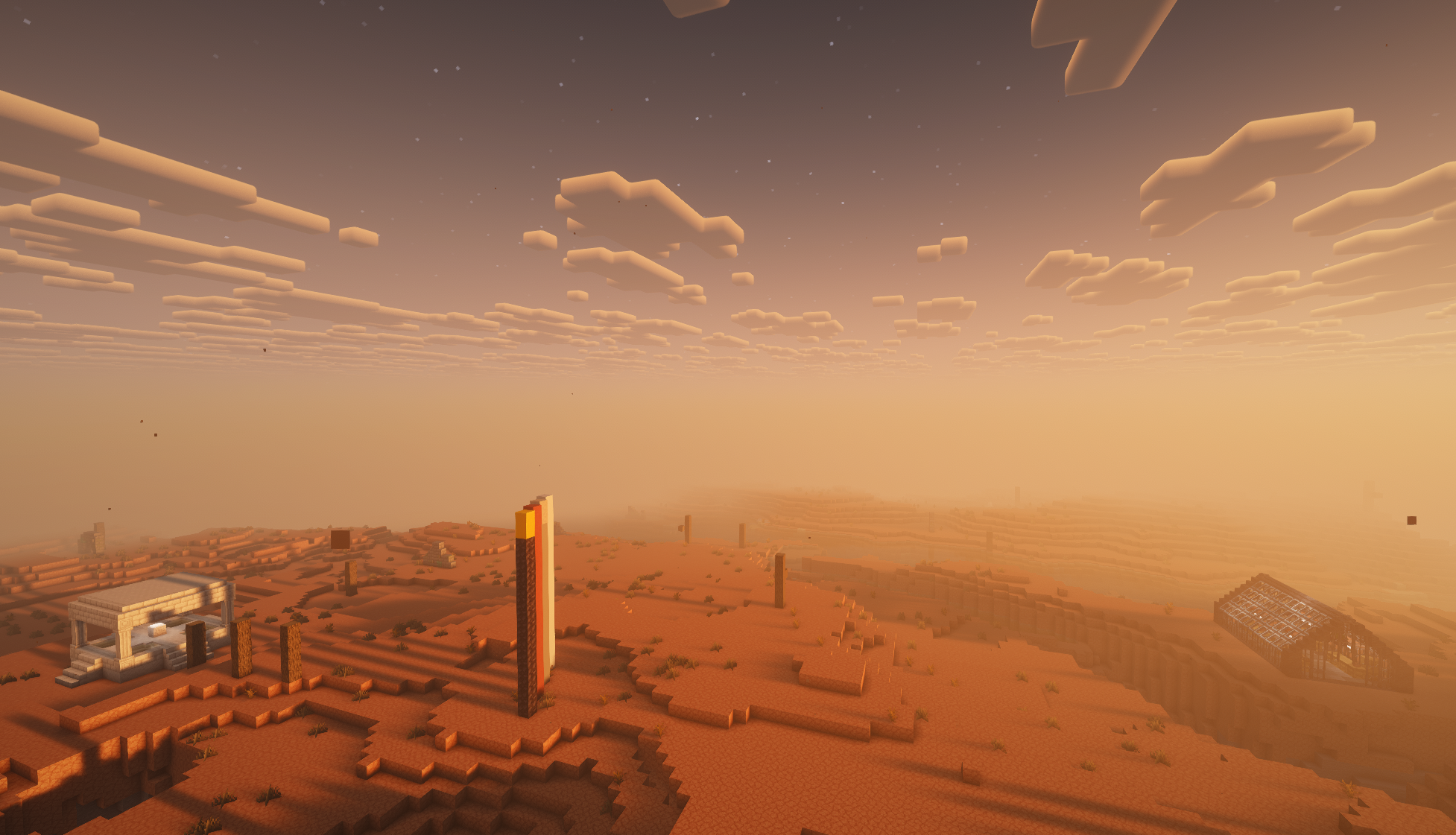
The more that I think about it, the more I am convinced that the wasteland in For the Trees (FTT) is an example of what J. G. Ballard referred to as a spinal landscape.
In an interview with George Macbeth for the BBC, Ballard describes a spinal landscape as something entirely artificial — say, the desert in a painting by Salvador Dalí — that comes into existence as a kind of “middle ground” between the private worlds of individuals and lived reality. The FTT modpack is exactly this: a kind of half-digested stew (Ballard says “goulash”) of hardware, off-the-shelf software, received narratives and collective imaginaries, fragments of popular culture, art, philosophy and history, and the constructions, coding, beliefs and fevered imaginings of the TAG Minecraft Bloc.
The area we settled is an allegory for this condition, a three-dimensional version of James Marsh’s covers for the Paladin Books editions of Ballard’s work in the 1970s. The Svalbard seed vault, an abandoned greenhouse, Andrew Rogers’ land-art sculpture “Elements”, a pagan temple or two, an oil derrick, and an oasis with palm trees, a hammock, a crackling fire, a garden gnome and a camel all erupt out of the cracked mud. These objects are the mute detritus of 21st century waking life, posing questions about the significance of their presence that they refuse to answer.
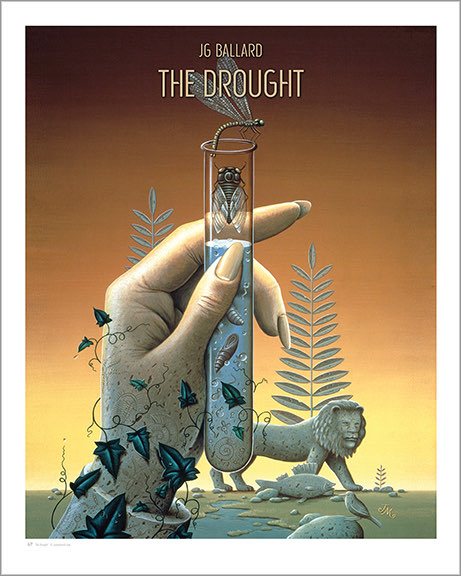
In the 1960s, Ballard was already convinced that the job of artists and critics was to “isolate the real elements” from the confections and irrelevancies. As we play-test, we’re performing a forensic-material dissection of FTT’s infrastructure, hardware, software, and procedural logic at the same time as we’re constructing it. There’s a story, and it’s a good one, but it hardly ever comes up.
We’ve written a good chunk already about SunBlock’s infrastructure and hardware, and the software of our various modpacks, and there’s more coming. However (and this is why Ballard comes to mind), what I have been thinking about today is that affect is also real and material. The supposedly rational and clinical debugging process produces some serious emotional charge, shoving cold metallic fingers deep into your lizard hindbrain and stirring up all kinds of weird and intense emotions.
The affective experience of play-testing a modpack you helped create is a lot like driving a car. In both a game you’re playing and a car you’re driving, your sensorium extends sensitive little tendrils into the technological exoskeleton around you. In exactly that process of extension and amputation that McLuhan described, the boundaries between “you” and “it” start to blur.
When everything works, it’s exhilarating; driving cars and playing games are still two of our most powerful routes into the technological sublime.
When something goes wrong — there’s an accident — your reaction is also deeply personal. It’s “You hit me, asshole!”, not “Goodness. Your car seems to have collided with mine.” Making mistakes, breaking things and causing problems is visceral, charged, immediate. It takes effort to slow down and figure things out, because somewhere deep in your spinal landscape, something cold and reptilian, full of hate and fear, has taken the wheel.
Case in point: in today’s FTT playtesting session, I broke the iron production progression path. If you play a lot of Minecraft, you already know that this is a Very Bad Thing. If you don’t, take my word for it.
Over the preceding hours, I had patiently assembled a complex machine that required three different compounds (all produced by other complex machines I had assembled the day before) plus fuel (which needed to be gathered and processed) in order to for the machine to work. I loaded (not “my avatar loaded”) everything in its proper place, added the fuel, and smoke began to billow out. I reached into the machine and pulled out two ingots of iron. Success! But.
There was a loud POPping noise. The next time “I“ reached into the machine, I received an error message about a missing model, and, instead of iron ingots, “my” hand (not “my avatar’s hand”) pulled out a stack of cartoonish “NO” pictograms: red circles with a 45-degree diagonal slash through them. The digital Real — something Not Supposed To Be In This Game — was in a neat stack in my hotbar, and it was deeply distressing. The lizard took the wheel.
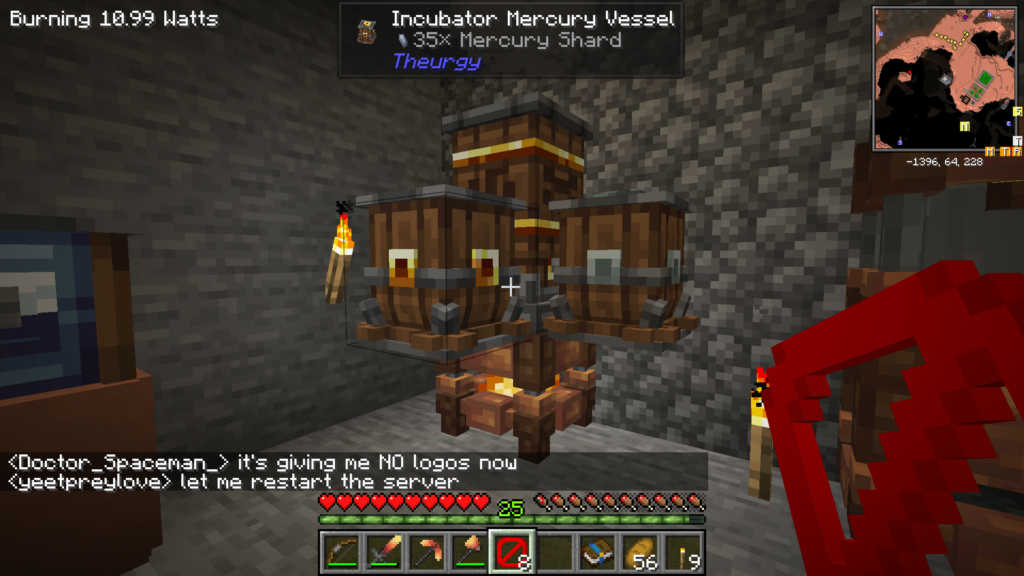
I started jabbing my keyboard. In the gameworld, I yanked the compounds out of the machine and replaced them with fresh ones. Nothing. I began to break components off the machine and slap them back into place. Nothing. I destroyed the machine’s component parts and rebuilt them from scratch. Nothing. Yet the precious compounds that it took so long to prepare were being consumed slowly and steadily, leaving only smoke behind them.
Rosie logged in to investigate, hovering and flitting and teleporting around the map in a blur of concerted action. Not only couldn’t she make my machine work; hers had also stopped producing iron. Rosie logged out and started looking at code, isolating the real elements of the problem from their manifestations in the game world.
My kids were home from school, and they had questions. The dog wanted out. The oven was on full blast, but I hadn’t put dinner in yet. The dryer was buzzing.

The lizard, thrashing through the shambles it had made of its neat Minecraft laboratory, had other priorities.
Five hours into the future and thousands of kilometers away, Bart was watching my increasingly agitated exchanges with Rosie though the server Discord. Apparatus and infrastructure, he reminded me. Isolate the real elements, said Ballard. But if it affected Rosie, I typed, it couldn’t just be an issue with my client. Could it?
I logged out of Minecraft and Forge and logged back in. Nothing but smoke greeted me in the lab. I logged out again, restarted my computer and logged back in.
There were iron ingots in the machine. Not the correct number of them, but something was better than nothing. The lizard slipped back into the muck, baleful eyes just above water level.
This sort of playtesting is emotionally fraught. On one level, you have helped make a Thing that you enjoy using with others. On another, you are supposed to break the Thing, coldly and systematically, and to be able to describe what you did and what happened in a manner that’s useful to your teammates writing the code, to prevent others from experiencing what you have just experienced. But if you begin to suspect that the problem with the Thing you have been talking about for the last hour is not systemic but local to you and your ancient, crumbly potato of a computer, the situation becomes more complex, because you begin to worry, with more than a little shame, that you may have been crying wolf (lizard) all along, and that your friends and teammates have better things to do than sort out your incompetent ravings.
I was deep in this swamp of miserablism when I noted that Rosie and Will had been chatting about all of the above in another channel. Rosie asked Will if this sort of event had occurred before, and, it had, as a result of a change in the code to tags on objects in the game.
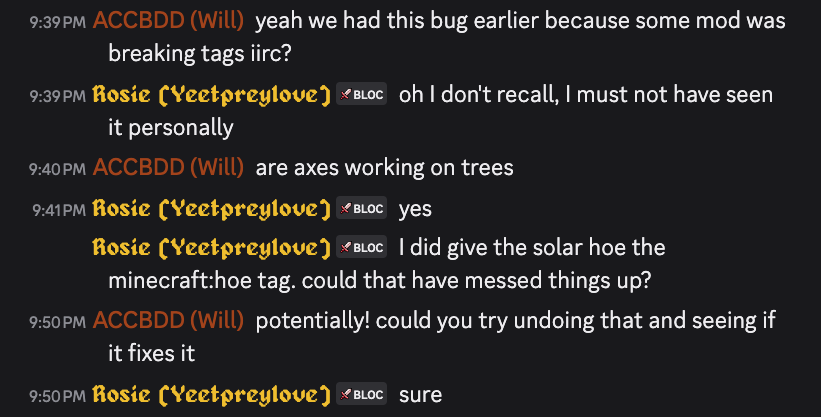
Rosie had been writing code to fix our brand-new Solar tools — a sword, shovel, axe and hoe that gain power and efficiency as the SunBlock server charges during the day. These tools are a huge part of our additions to the game; they connect the server apparatus to events inside the game world in a way that few other mods have ever tried. It’s an ambitious project with a steep learning curve … bound to create problems. Rosie had added a tag to the hoe, the newest of these tools, and, after sharing some code in the chat, she and Will decided it broke the game. They fixed the issue and moved on.
I don’t take this turn of events as a vindication because none of the above is about being right. Playtesting is an inherently collective process, and an inherently messy and uncertain one.
The last time I did anything like this was in the previous century, around 1997, when I was working on an expansion for the original StarCraft with another group of smart, talented, funny people. That was 30 years ago, longer than some of the people on the current project have been alive, and I am once again far out of my depth. No wonder the huge currents of affect roil around. We are in a new world, a spinal landscape whose specific material conditions connect us to instincts and feelings we might rather deny existed at all; we would prefer to be above them.
But. As we sit and type and ponder and peer into our very expensive machines, the wasteland shows us who we always have been by refusing to be the way we would like. Instead, it shows us what we are.