The Larch
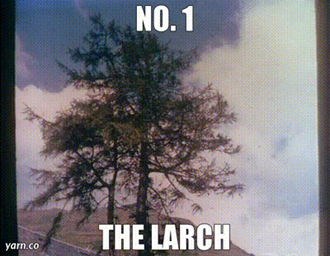
Readers of certain age will grasp the Monty Python meme immediately (for the rest)… I keep thinking of this as I place various saplings around my base in our current playtest of For The Trees (our solar powered SMP launching on May 24th). The Larch is one of over three dozen modded tree species we are featuring in our game interpreted through the biome mods, Nature’s Spirit and Regions Unexplored. Normally, the trees in these mods are part of the distinct landscaping of transformed and enhanced vanilla biomes and while they a critical part of the worldbuilding of the modded game they often become part of the background of normal adventure and exploration play. There are usually no game goals specific to the trees as such.
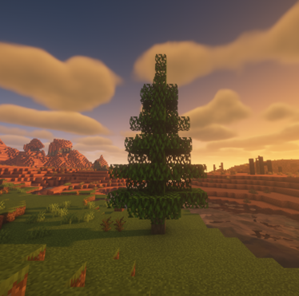
In our game the world starts with no distinct biomes and no trees (sort of… no spoilers). The players must work to generate these biome by biome, sapling by sapling. An entire quest line involves a painstaking methodological process of crafting vanilla saplings, through tiers of modded saplings until you perform the ritual to produce a Ghaf tree sapling (the mythical “tree of life”) which will unlock the ability to renew the world’s biomes, generate new flora and fauna, and end the game (almost… I am avoiding more spoilers here). Because of this each sapling becomes special in its own way as quest goals, end game requirements and overall aesthetics and worldbuilding. Players need to be concerned with where the trees come from (how they will be obtained), how they will grow (as bonemeal is disabled), and how they might interact with other trees and flora in players’ efforts to the create the forests which define the end of the game.
At least as far as our current playtest goes, I think we have succeeded in offering an opportunity for players to think about trees in way they usually don’t in Minecraft. We are mindful that we are not attempting to produce any kind of ecological simulation however. This is not a game about ecology or dendrology (the study of trees) but an allegorical prompt about players’ relationship to climate in general and trees in particular all in reference to our experience and understanding of how Minecraft is normally played.
Atypically, in our game, the modded trees that players will plant are no longer necessary as lumber resource (that is resolved in the early game) so while their may be a desire for the aesthetic qualities of certain woods (across a range of textures and colours) leading to some light harvesting, most of these trees will likely not be cut down. In addition, the game incentivizes players to plant more and more trees – far more than they would ever consume as an extracted resource.
The utility of this from a gameplay perspective comes in prompting players to engage in the creative design of forests as allegorical play. These can be sparse or dense, “industrial” or “natural”, composed or wild with no barriers to multispecies mixes that make no ecological sense.
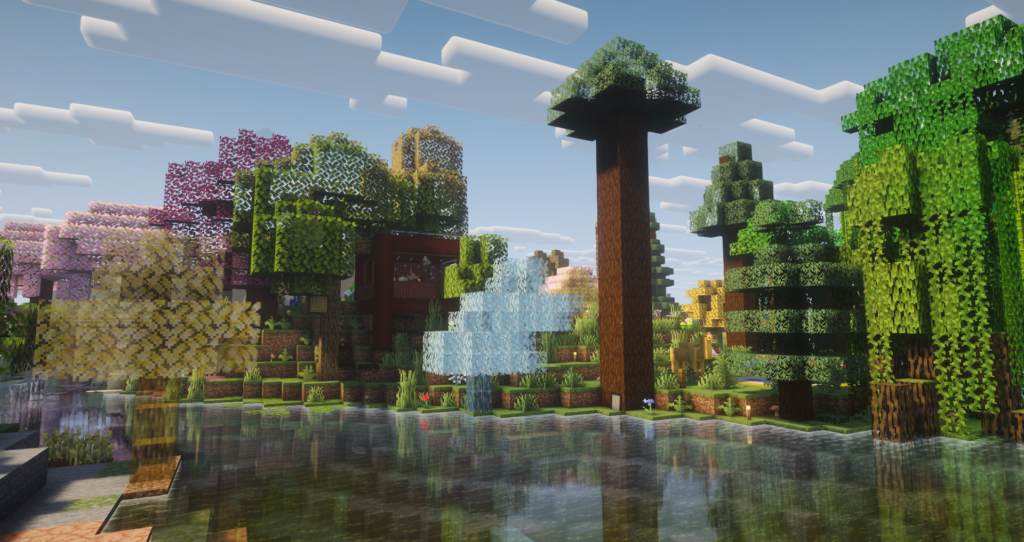
You want a stand of birch to underplant your kapok canopy mixed with giant redwoods? Go right ahead! The point here is that players could enact their understanding of ecology or not as they see fit but in doing so might develop a different allegorical relationship to the idea of trees in the game.
The point is to traverse a range of possible mechanics and see if we can make trouble with them in a productive way. All players generally start by making a homebase to store their accumulated materials, craft complicated multiblock machines and devices, express their creativity and identity, and be relatively safe from mobs at night. Trees are usually planted around the homebase as ready to hand lumber or to cultivate a naturalistic aesthetic and large landscaped gardens and arboretums are common features of many bases in a typical Minecraft playthrough. This kind of Minecraft gardening treats trees as specimens in relation to architectural and landscaping features such as houses, fences, lawns and ponds.
We try to mess with this is a few ways. Firstly, as I wrote in a previous devlog we have disabled the ability of bonemeal to near instantly convert saplings to trees. This means players must wait to see the how the tree looks in its given placement and challenges the player to adapt to the procedural variation in the trees rather than simply planting, bonemealing, and cutting down the tree until the desired “look” is created. Forcing trees in less than ideal conditions, bonsai’ing and pruning are still all possible of course but in general the act of gardening requires more planning, patience and adaptation than is typical.
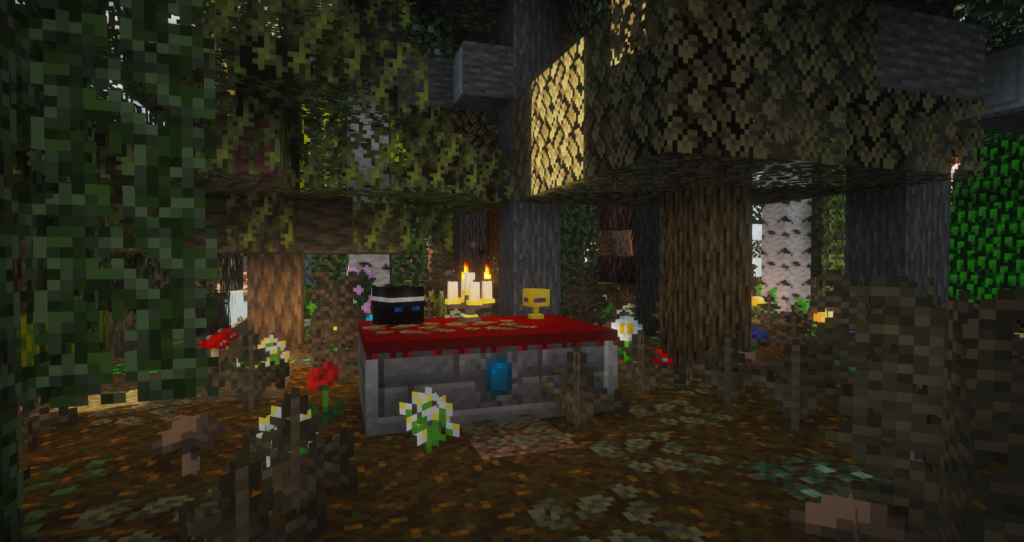
Secondly, the Enchanted: Witchcraft mod (by Favouriteless) has an excellent mechanic which uses trees and plants to supply power to a nearby ritual altar. Crafting recipes can use altar power which requires players to puzzle through dense plantings of a variety of trees and plants within a specific radius, and this leads to some pretty spectacular and wild looking gardens which are again, atypical.
Thirdly, the players are tasked with planting enough saplings to end the game (there is a sapling counter in the HUD) and this requires players to imagine and create forested spaces beyond the gardens of their homebase at a scale that is uncommon for most Minecraft games. How players manage the logistics of this, work with the procedural landscape, and imagine new woodland spaces becomes the central focus of the endgame. We do not know in advance how players will engage with this opportunity so most of our design work is about making this as enticing as possible within the frame of the genre.
In our playtest world I am struggling with it… the impulse to garden is overwhelming. As I create a modest stand of baobab and eucalyptus underplanted with oak I am eying the landscape and placing each tree for some imagined aesthetic effect.
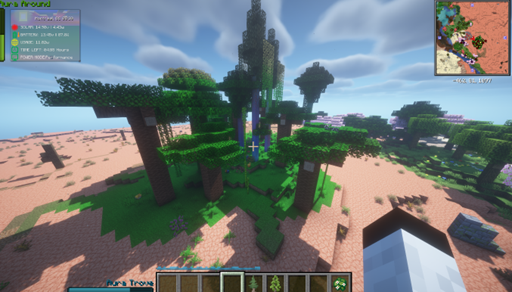
Its very slow work and I can’t possibly hope to end the game this way. In this gardening/arborist mode I might cover 50 or 100 blocks an hour when I need to cover 1000s. The sense of scalar difference hits home and only really becomes perceivable when flying in the sky or on the world map. I wonder, is this kind of shift in perspective from the trees to the forest what our new climate consciousness requires?
I try to put myself in the shoes of my younger self working briefly as a tree-planter (my friends would spend whole summers but I couldn’t stand the black flies) methodically digging holes and adding a sapling in rapid mindless pace, but the effect seems industrial and boring – who would want to roleplay being be a tree planter of this sort? More rewarding is the Supplementaries mod cannon that can shoot saplings in high arcs that plant when they hit the ground, but I discover this is also slow going. I am eager to test our hacked Create mod potato cannon that will rapid fire saplings (and can be dual-wielded) as well as flying on my Enchanted: Witchcraft broom to sky bomb saplings from above.
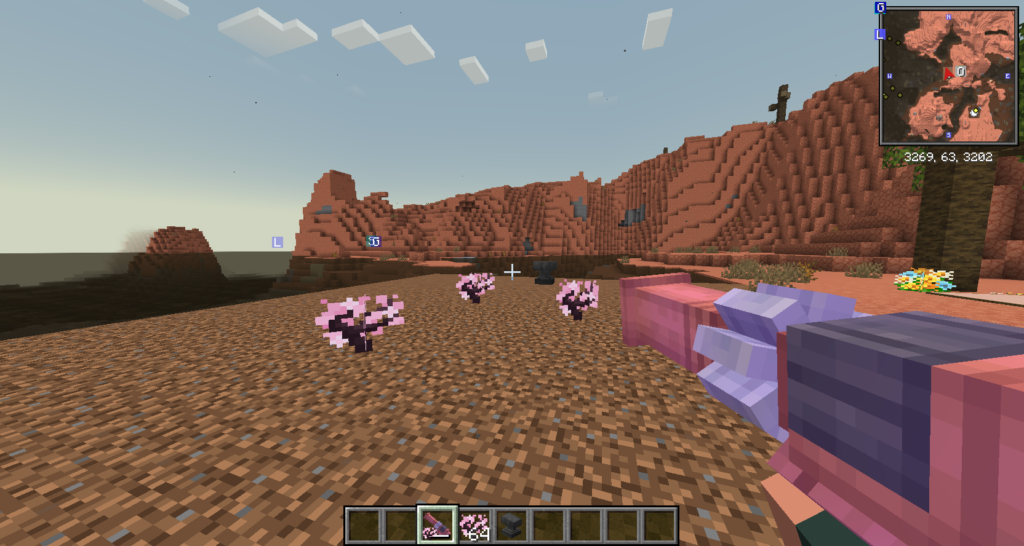
Ultimately though as a single player game this experience breaks down and it is a strange kind of hardcore game to get these saplings in the ground. I think its simply too much for one player so I am eager to see what happens in our SMP when a group works to tackle this project together. See what I did there? Climate resilience as a social problem is made allegorically self-evident in modded Minecraft.
Slide Number 1. The Larch.
Kumbaya.