Manufactured Landscapes Part 1 – Firewatch
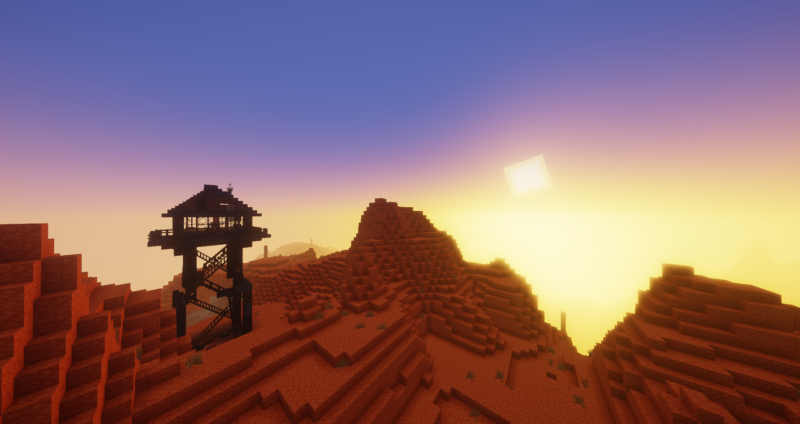
I’ve been teaching myself how to create custom structures in Minecraft. Now that I write it out, it sounds a little funny because isn’t building structures kind of the whole point of Minecraft? Isn’t it a big sandbox where you stack your blocks to build castles? Turns out that yes it is, but to an even greater degree than I had previously realized.
The base game might be mostly sprawling “wilderness” (a hotly contested term), but there are a wide variety of structures/constructions which come along with the more natural aspects of the world. There are practical “man-made” structures like villages and pillager towers and mansions, there are more mystical structures like the ocean monument and ruined nether portals, and there are structures which clearly point to a distant and ruined past- the abandoned mineshafts, the jungle temples, and the ancient cities. In a Minecraft world there are signs of a past civilization, and since I first began playing I’ve always interpreted those signs as pointing to a devastating collapse.
It wouldn’t be too difficult to make the argument that Minecraft exists in a zombie apocalypse, and what’s especially intriguing to me is that there are multiple kinds of zombies. The game’s NPC villagers, the pale-skinned hemming and hawing labourers that dwell in villages and are economically exploited by the players, can turn into zombified versions of themselves if attacked by another zombie. The zombie villagers, however, are visually quite distinct from the other zombies (including the watery drowned and the desiccated husks) in the game- their proportions are completely different. Zombie villagers look like villagers, while the other zombies look like the player.
My head-canon is that the people who built the mineshafts, the ancient cities, the ocean ruins, and likely the other abandoned and disused structures, fell to an apocalypse. The zombies and skeletons that roam the world are all that remain of the civilization that once existed, and now the living villagers and player characters are settling in and amongst its ruins.
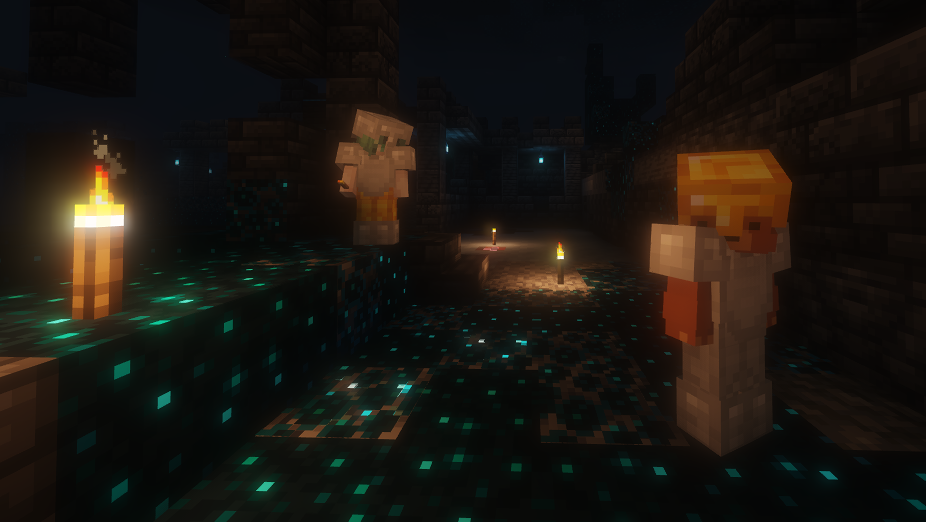
This is something that I’ve been keeping in mind as I’ve been designing and building the structures for our most recent project- I also want what I build to be evidence of a former civilization. The new game that we’re working up to takes place in a total wasteland. The trees are gone, the water is putrid, there are no ores remaining in the ground. Some of the evidence I have decided to leave is that of a civilization that became aware of a coming catastrophe and tried to avoid it. In this series of blog posts, I’d like to explain my thought process behind some of the structures I’ve been working on, what it’s been like to build them, and how they’re informing my relationship to the game. First up: the firewatch tower.
The Firewatch Tower
When we were nearing the end of the Gaia’s Riddle SMP in the summer of 2025, we entered “forest fire season”. Forest fire season is fast becoming a new reality for residents in this part of the world, and I’m assuming many others. Each year more and more of the forests burn out of control, and the wind shoots the smoke hundreds of kilometers away from its origin. The island of Montreal had brownish-orange skies and days-long air quality warnings. We were in the middle of running an experiment using solar panels and we had to wonder- can we still count on solar power if the smoke from the burning world blocks out the sky? I can’t speak for the other research team members, but I think this was when we started to think about centering forests in our future projects.
Forest fires in Minecraft are always a possibility, usually caused by a lightning bolt or a lava pool generating too close to vegetation. I wanted to bring something into our game world that suggests whoever might have inhabited the land were used to fires and wanted to be able to spot them quickly. I also wanted to build a structure that was a nod to the brilliant Burnt mod that we are including in our mod pack. Burnt is a mod that changes how fire spreads and behaves, adds an incredible selection of new blocks (including some that are smouldering and glowing with embers, and some that have been reduced to disintegrating soot), and fire-related tools like extinguishers and protective suits. Please be assured that I don’t engage with these destructive mods without a healthy dose of internal conflict- it feels weird to be excited about a well-made fire mod while the real world burns, but that’s probably another blog post in and of itself.
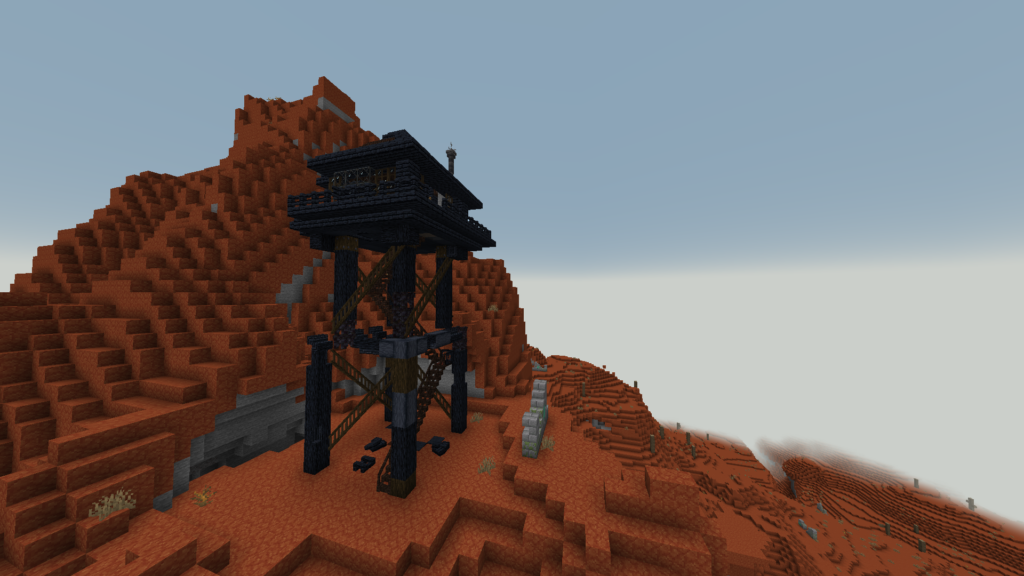
To showcase both the Burnt mod and a world in which it would exist, I have two different versions of a firewatch tower- one that is intact and one that is, well, burnt. First I built the complete tower and saved it as an .nbt file. Then I set it on fire, let the procedural destruction of the Burnt mod wreck havoc, and saved it again.
My favourite pixel artist, Jubilee, stays in firewatch towers in the Pacific Northwest every summer and shares pictures and makes art based on her time in the woods . I find her artworks particularly inspirational for this project- while not part of any particular game, the pixelated landscapes are right at home in the ecogame genre. She makes digital art inspired by the natural world she observes during her trips, recording the landscape that the tower exists to protect. I loosely based the shape of my tower on her work, and lightly furnished the interior with a bed, a stove, a tea kettle, and a fire extinguisher. Both versions of the tower, whole and burnt, are intended to be a tragic discovery. There is no forest to watch, and the burnt version suggests one possible explanation for where it went.
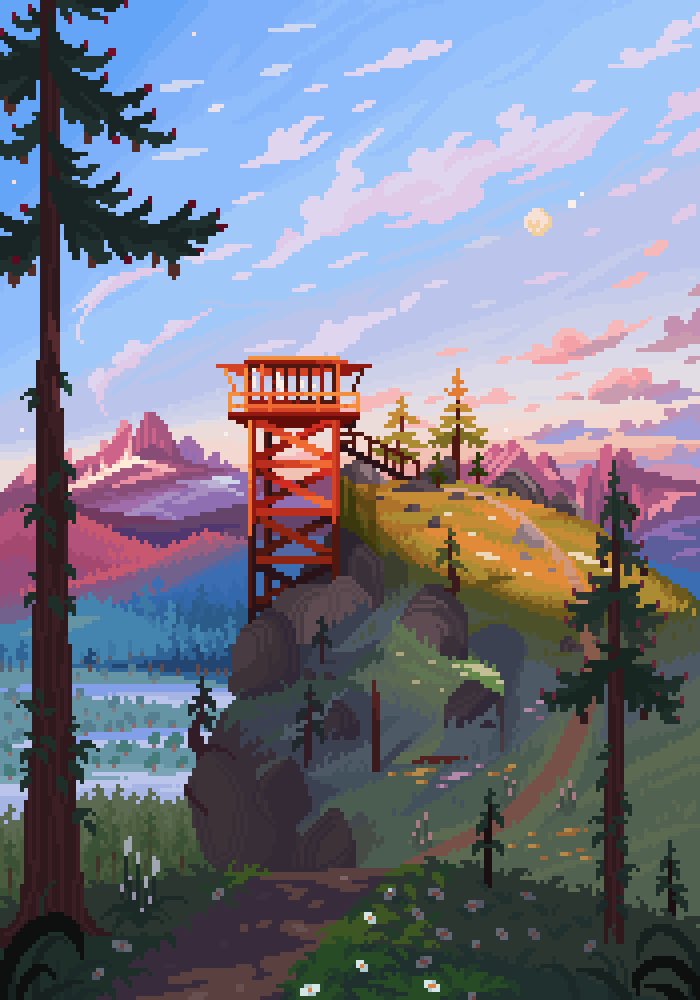
Where we as individuals and we as members of communities fit into environments and ecologies is crucial to what we’re exploring with this project. In fact, we’ve gone through quite a few different titles for our modpack, many of them touching on the relationship between the player and the trees or the forests that we hope will return to the landscape- “Forest Keepers”, “Forest Wardens”, etc. What kind of relationship to the forest does the tower represent? Is the tower occupant a sentry or a witness? Is it a position of authority or a position of supplication? How does that relationship change once the forest is gone? If the tower were a monument, what would it be for?
On the government website used to book a stay in a (real world) tower it is made extremely clear that these trips are not to be taken lightly. Most towers have no electricity, no running water, and minimal cell service. Visitors book 6 months in advance to spend up to two weeks utterly isolated but with a breathtaking view. Here’s part of the description for the Werner Mountain Lookout in Oregon:
This is a very remote location; the road to the lookout is not plowed or maintained for winter travel. The lookout can only be accessed by skis, snowmobiles or snowshoes, a distance of 2-10 miles. Conditions on the mountain change rapidly. You need to be evaluating conditions and weather throughout your stay. Sudden storms and high winds may make skiing and driving conditions difficult. Experience in cross-country skiing or snowshoe travel is highly recommended. Guests are responsible for their own travel arrangements and safety, and must bring several of their own amenities.
The reward is worth the effort of getting there. Guests will enjoy panoramic views of the pristine snow-covered landscape and starry skies on clear nights.
As of writing this, the towers in the game can only generate in the mountainous biomes of the world, making them the rarest structure we are adding to the game. Reaching the tower will take something of a pilgrimage as a player will likely have to travel over 10k blocks to find one.