Designing Minecraft Spaces
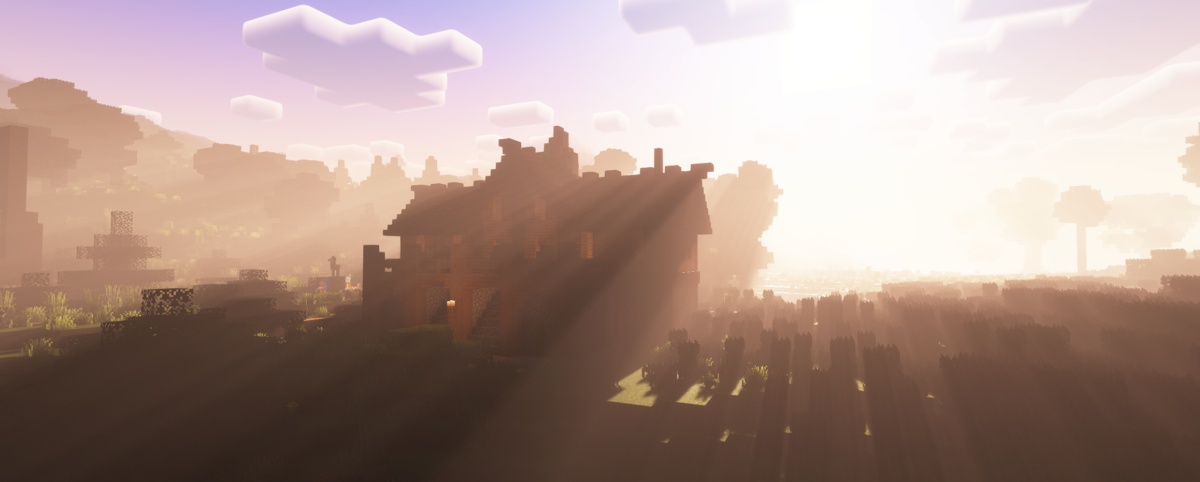
I’ve been thinking a lot about what makes someone want to design a space in a game. Before I was a part of this team of academics; before the theory, the mods, and the solar panels—my love of Minecraft stemmed from building.
Part of it is obvious: the game Minecraft is structured so that it allows players to easily express their tastes and interests through building. In Minecraft, one can recreate a childhood home, a brutalist monument, a fantasy castle, or a dirt hut with a lonely torch in the corner. The blocks remain neutral until a player arranges them, giving them the idea that this world is primed for their customization. The thing is, Minecraft worldgen is anything but a blank slate.
The environment of the game pushes back in subtle ways.
In the case of vanilla Minecraft, there are mountains where you didn’t plan for them, biomes that don’t match your aesthetic, daylight cycles that interrupt your work, and mobs that wander too close for you to sleep. Even when the game space feels open, it is structured by the constraints of the game’s mechanics. This is part of the appeal to me as well: there is something satisfying about appreciating those constraints rather than bypassing them.
Instead, ask yourself: why are these here?
Modded Minecraft offers its own array of things to consider, and opens up a whole other world of people engaging in the game in their own ways. The variety of blocks accessible to the player can be drastically altered, depending on how the game has been modified. Regardless, access still unfolds over time. When does one cross the line between having the blocks that you need to survive, and finally unlocking the materials you need to be able to stylize something—what makes it distinctly yours? I am pinpointing a difference in how it feels to build for the sake of survival as opposed to building to be able to express oneself.
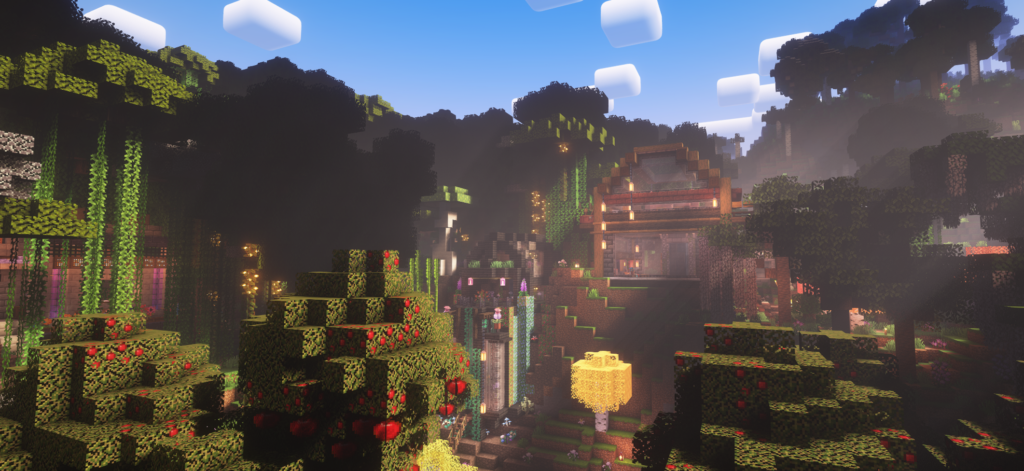
In survival mode, design is actively shaped by necessity. You build near your spawn, or else you have to lug a full inventory to some distant location. You build with the resources that are available to you, and nearby. You compromise with the structure of the game. Later, when you have worked to gather more resources, the aesthetic layer arrives. This delay matters, because it makes the player feel as though they have earned the right to make a space their own through hard work and patience.
Creative mode collapses that gap entirely, making everything available instantly. The friction generated by making the player wait is replaced by a different kind of tension. The question becomes, If I can build anything, what do I build?
Here is where player context becomes important.
What is your history with Minecraft? Did you grow up playing it? Are you running it on a MacBook that sounds like it’s about to take flight? A desktop computer built to run heavy games with shaders turned up high? The hardware shapes the space as much as the players and the blocks do. Frame rates affect how easy it is to play, shaders change the mood and the aesthetic profile, and sounds impact how immersed a player feels. Sensory details like the music that plays, the crackle of the furnace, or the way footsteps sound different depending on the blocks you walk on makes a space feel real around a player. They feel within a space. This is a condition of the game without the player having to place a single block. The context of the player changes the way they interpret the game through these sensory functions, and ultimately impacts how they engage in the space.
With multiplayer Minecraft, there is an entirely new social layer that begs consideration.
Sometimes, when I build, it’s because I want to share the space with someone else. A base becomes a space for friendship, and collaboration. A house serves as proof of my participation on the server, and where I locate myself according to the other players changes how they will interact with me online. Design becomes a negotiation when you decide to settle down with another player, especially when that means sharing a storage system. Your building becomes a space for shared memory, where someone other than yourself can move through it, notice it, and respond to it.
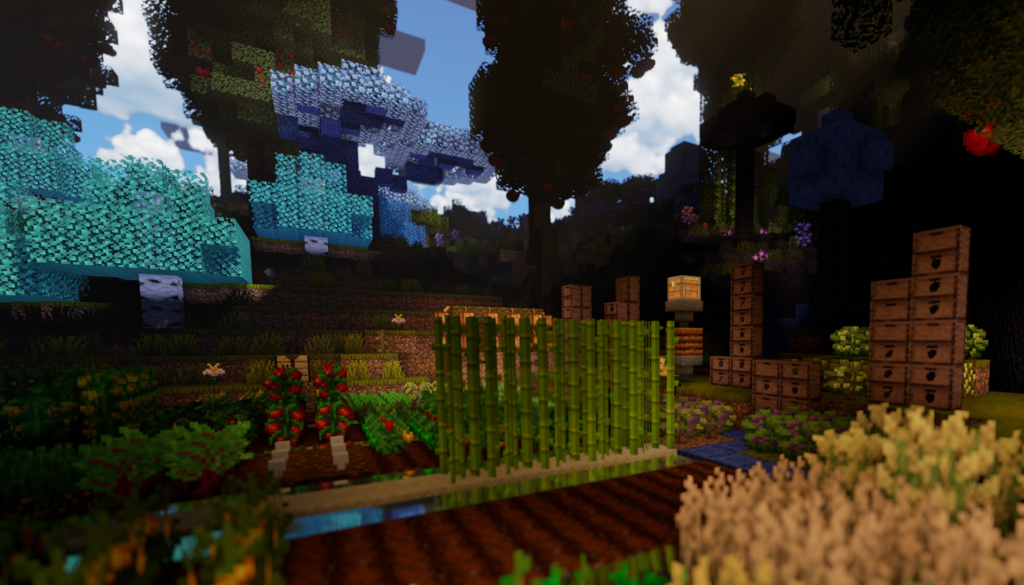
This is what makes Minecraft so compelling to me. It offers abundance and customization, yes. But it’s to the degree that you set it to. You download the mods. You pick your game difficulty. You decide who you want to play with, and what aesthetic you’re going for.
The open-endedness of the game allows the player to bake their own technical, sensory, and social conditions into it. Because every element is reduced to a block, the world feels endlessly reconfigurable. The stripped-down geometry of Minecraft’s blocks turns the landscape into something negotiable, a world of possibility that already exists and invites rearrangement. Maybe that’s the real reason we build in it. Not because it’s empty, but because it isn’t.